
Beyond OWASP Top 10: Mapping Application Security Across the SDLC
1. Introduction
In modern software development, security is often treated as a final checkbox—a gate to pass just before production. However, as software systems become more complex and development velocity increases, relying on a single final check becomes a recipe for failure. Real security requires integrating security activities throughout the entire development lifecycle.
2. Why OWASP is broader than the Top 10
Many engineering and security teams associate the Open Web Application Security Project (OWASP) primarily with the "OWASP Top 10." While the Top 10 is an excellent awareness document for identifying common web application vulnerabilities, it is not a complete security program.
OWASP is much broader than a vulnerability list. It encompasses a rich ecosystem of tools, standards, testing guides, and models designed to build security into every phase of software development. To build a robust security posture, organizations need to look beyond the Top 10 and map these diverse projects to their daily workflows.
3. Mapping Application Security across the SDLC
How can teams align OWASP projects across different stages of the Software Development Life Cycle (SDLC)? The Application Security Wayfinder, a tool developed by the OWASP Integration Standards Project, provides a visual guide and interactive map. It helps teams identify which OWASP resources are most relevant at each stage of their pipeline.
By using the Wayfinder, organizations can transition from ad-hoc security scanning to a structured, repeatable security assurance process.
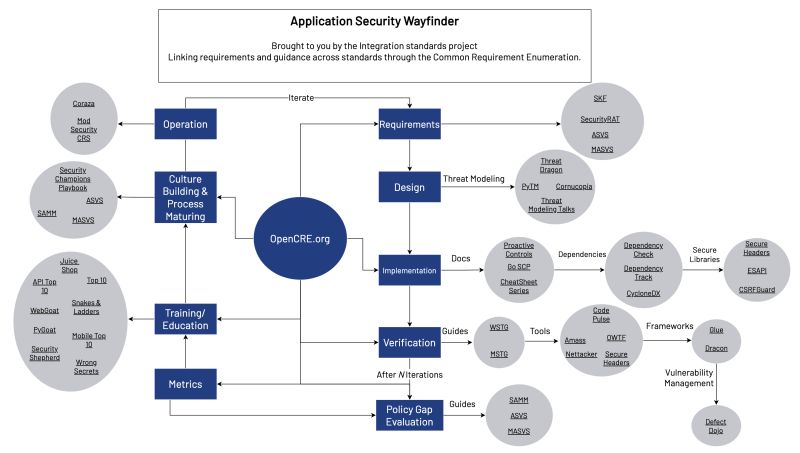
Diagram credit: OWASP Integration Standards Project. Source: OWASP Integration Standards Project.
4. Requirements phase
Building secure software starts before writing the first line of code. During the requirements phase, teams should define clear security expectations.
- OWASP Software Security Framework (SKF): Helps developers learn secure coding practices and define security requirements based on the application's tech stack.
- SecurityRAT (Security Requirement Action Tracker): Enables teams to automatically generate and track security requirements for new features.
- OWASP ASVS & MASVS: The Application Security Verification Standard (ASVS) and Mobile Application Security Verification Standard (MASVS) provide a structured framework for defining baseline security requirements.
5. Design phase
During the design phase, teams should analyze the application's architecture to identify structural security flaws.
- OWASP Threat Dragon: An open-source threat modeling tool used to create data flow diagrams and systematically identify threats.
- pytm: A Python-based framework for threat modeling as code, allowing developers to define system boundaries and components programmatically.
- OWASP Cornucopia: A card game designed to help developers identify security requirements and model threats in an engaging, interactive format.
6. Implementation phase
During coding, developers need active, developer-centric guidance to prevent vulnerabilities.
- OWASP Proactive Controls: A set of concrete development recommendations that define the most important security techniques every developer should implement.
- OWASP Cheat Sheet Series: A high-value repository providing practical, developer-focused guidance on specific technical topics, from input validation to session management.
- CycloneDX: A lightweight Software Bill of Materials (SBOM) standard used to track third-party library dependencies and verify supply chain security.
7. Verification phase
Verification ensures that security controls are functioning as intended before the application goes live.
- OWASP Web Security Testing Guide (WSTG): The premier framework for testing the security of web applications, providing a comprehensive set of testing scenarios.
- OWASP Mobile Security Testing Guide (MSTG): The equivalent testing framework tailored for mobile applications and APIs.
- OWASP Amass: An open-source tool for in-depth network mapping and attack surface discovery.
- OWASP Secure Headers Project: Provides clear guidance on configuring HTTP response headers to harden applications against common attack vectors.
8. Policy gap evaluation
To understand the overall maturity of an organization's security practices, teams must evaluate their policy and process gaps.
- OWASP SAMM (Software Assurance Maturity Model): A comprehensive model that allows organizations to self-assess their security posture and formulate a structured roadmap for improvement.
- ASVS/MASVS-Based Gap Reviews: Auditing existing systems against verification standards to detect policy gaps.
9. Vulnerability management
Finding vulnerabilities is only half the battle; managing and remediating them efficiently is crucial.
- OWASP DefectDojo: An open-source vulnerability management tool that aggregates findings from various scanners, tracks remediation progress, and integrates directly into CI/CD pipelines.
10. Key Takeaway
Application security is not just about finding vulnerabilities. It is about building a structured, risk-driven, and repeatable security assurance process across the SDLC.